Many students came to study with this teacher. He was very strict yet deep in his heart. He didn’t hesitate to criticize his student during the lesson. One day, the teacher asked a student to play for him. Unsatisfied with his performance, the teacher asked a female student next to him and asked for her opinion. She said, “It was machine like.” This teacher didn’t like how the student played the piece with no heart. This student eventually became a good player, even though this teacher’s opinion about this student did not change.
Another time, there was a foreign student who came to study with this teacher. This teacher kept reminding this student that he was not doing right on many points. The teacher finally asked another student to translate his advice into English so that this student could understand better. After hearing his advice in English, the student became grumpy and stared at the translator. The translator told the teacher: “I don’t want to get involved in this. You better ask those female students to do it, as he is not going to listen to me.” Since then, the teacher stopped giving detailed advices to this student. Even so, this student was eventually granted a shihan license. "Why?" Some of his students asked. The teacher responded: “Because he insisted that he needs a teaching license to get a teaching position in his country.”
Although this teacher didn’t like these students’ performances, they became good players. It indicates, however, that their spirits were different from what the teacher tried to cultivate in them.
Sunday, August 29, 2010


Monday, August 23, 2010
Take ni awasete fuku
Depending on the character of the flute, the player needs to accommodate his or her playing style, even embouchure in order to play it. (Japanese expressed this pedagogical idea by saying take ni awasete fuku, or “blowing according to the character of each piece of bamboo”).
Shimura Satoshi uses the term “Iki no michi” (“route of breath air”). He claims that the ji-nashi shakuhachi, especially old ones made during the Edo period, shows a wide variety of differences. These flutes do not sound resonant unless the player accustoms himself to its character brought by its unique, innate bore shape. The player needs to change his blowing style in the way that the air passes through a uniquely shaped inner space of the bamboo. This process requires months of practice and acclimation. (In the interview posted earlier, he described that he had come across ji-nashi that didn’t sound well initially but later changed his impression).
Toya Denko (1984) goes so far as to say that the air carves bamboo:
The ji-nashi shakuhachi is different from one another in terms of inner bore space. The player needs to get used to its own blowing style. Otherwise, the pitch may be inaccurate and the sounding may not be rich. However, as he plays it for some time, he understands the tips of how to blow into it. Because it does not bear a filling material inside the bore, the bamboo fabric may naturally be shaped in time [by blowing air] in a way that it resonates well. This transformation is called “road takes shape” (michi ga tsuku).
How long does it take to shave the bore until the bamboo sounds good? Must be more than a couple of months. Not my experience.
Shimura Satoshi uses the term “Iki no michi” (“route of breath air”). He claims that the ji-nashi shakuhachi, especially old ones made during the Edo period, shows a wide variety of differences. These flutes do not sound resonant unless the player accustoms himself to its character brought by its unique, innate bore shape. The player needs to change his blowing style in the way that the air passes through a uniquely shaped inner space of the bamboo. This process requires months of practice and acclimation. (In the interview posted earlier, he described that he had come across ji-nashi that didn’t sound well initially but later changed his impression).
Toya Denko (1984) goes so far as to say that the air carves bamboo:
The ji-nashi shakuhachi is different from one another in terms of inner bore space. The player needs to get used to its own blowing style. Otherwise, the pitch may be inaccurate and the sounding may not be rich. However, as he plays it for some time, he understands the tips of how to blow into it. Because it does not bear a filling material inside the bore, the bamboo fabric may naturally be shaped in time [by blowing air] in a way that it resonates well. This transformation is called “road takes shape” (michi ga tsuku).
How long does it take to shave the bore until the bamboo sounds good? Must be more than a couple of months. Not my experience.
Thursday, March 11, 2010
礫川餘光's interview with Tomimori Kyozan 5
Track 6
There is a variety of honkyoku pieces. Tsuru no sugomori in kinko is to be played for happy occasions. Following the san-san-kudo style of wedding ritual (shinto based), the piece repeats koro-koro 3 times and again 9 times. In time, the piece gradually changed like that, depending on who performed (altered) it. The myoan version of kyorei, too. The koro-koro phrase was omitted by Higuchi Taizan sensei because it is too difficult to play. Great masters can do it. But when playing in renakn (ensemble of more than 2 players) for kenkyoku (music offering), the koro-koro in ensemble doesn't go smoothly. The proverb says it takes 3 years to master the koro-koro technique. That's why Higuchi sensei deleted it. Just as he did, honkyoku became both sophisticated and spoiled due to players' additions. The style of ajikan that people play today is exactly the case.
Today, Ajikan is played quite differently from how Miyagawa Nyozan played. Although the form is the same, the level of spirit is different. Myozan's verve is no longer carried. The original of Ajikan, Sashi (that people play today), is rather closer to Ajikan in taste. Ajikan is an interesting tune. Sashi (that had been transmitted) in the Oshu area was brought to Fukuoka and became Shinhichi Sashi. This was brought to Kyoto by Miyagawa Nyozan. To this Higuchi Taizan in Kyoto added phrases from Koku as well as a melody taken from a shomyo song, Akigarasu (autumn crow), which became Taizan's Aji. It was Suenaga Sessan in Fukuoka who named Ajikan. Miyagawa Nyozan learned Oshu Sashi from Hasegawa Togaku who was the last abbot of Futaiken in Sendai, and Nyozan's Ajikan embraced his myoan style and the Oshu style of playing.
The reason why many people today play Ajikan in such a stagnant style is that many learned Ajikan from Tani Kyochiku who used 2.5 long shakuhachi. That's how it became a dull, dark song. Miyagawa Nyozan played it on 1.8.
Interviewer: There is a recording of Miyagawa Nyozan's Ajikan, even though the quality of the recording is not so great.
Kyozan: Yes, unfortunately, the recording does not carry the true sounding. To our ears, his playing actually sounded quite rough. But he had subtle expressions that nobody could imitate—the level of frantic playing. That is the true Ajikan that expresses the spirit of shingon's Ajikanpo (?). That is what is missing in today's performances. Only the form is imitated. People simply drag the song and extend the form.
Interviewer: There is also a recording of Nishimura Koku's Ajikan. He was a disciple of Tani Kyochiku.
Kyozan: Yes. Tani Kyochiku's Ajikan also carries some sort of taste and import when played with a longer flute. However, Miyagawa Nyozan said, "I wonder where he learned it from? If that is the Miyagawa Nyozan's Ajikan, it would be troublesome." I think it is fine if there is Tani Kyochiku's Ajikan. But he probably should have changed the name
of the piece.
There is a variety of honkyoku pieces. Tsuru no sugomori in kinko is to be played for happy occasions. Following the san-san-kudo style of wedding ritual (shinto based), the piece repeats koro-koro 3 times and again 9 times. In time, the piece gradually changed like that, depending on who performed (altered) it. The myoan version of kyorei, too. The koro-koro phrase was omitted by Higuchi Taizan sensei because it is too difficult to play. Great masters can do it. But when playing in renakn (ensemble of more than 2 players) for kenkyoku (music offering), the koro-koro in ensemble doesn't go smoothly. The proverb says it takes 3 years to master the koro-koro technique. That's why Higuchi sensei deleted it. Just as he did, honkyoku became both sophisticated and spoiled due to players' additions. The style of ajikan that people play today is exactly the case.
Today, Ajikan is played quite differently from how Miyagawa Nyozan played. Although the form is the same, the level of spirit is different. Myozan's verve is no longer carried. The original of Ajikan, Sashi (that people play today), is rather closer to Ajikan in taste. Ajikan is an interesting tune. Sashi (that had been transmitted) in the Oshu area was brought to Fukuoka and became Shinhichi Sashi. This was brought to Kyoto by Miyagawa Nyozan. To this Higuchi Taizan in Kyoto added phrases from Koku as well as a melody taken from a shomyo song, Akigarasu (autumn crow), which became Taizan's Aji. It was Suenaga Sessan in Fukuoka who named Ajikan. Miyagawa Nyozan learned Oshu Sashi from Hasegawa Togaku who was the last abbot of Futaiken in Sendai, and Nyozan's Ajikan embraced his myoan style and the Oshu style of playing.
The reason why many people today play Ajikan in such a stagnant style is that many learned Ajikan from Tani Kyochiku who used 2.5 long shakuhachi. That's how it became a dull, dark song. Miyagawa Nyozan played it on 1.8.
Interviewer: There is a recording of Miyagawa Nyozan's Ajikan, even though the quality of the recording is not so great.
Kyozan: Yes, unfortunately, the recording does not carry the true sounding. To our ears, his playing actually sounded quite rough. But he had subtle expressions that nobody could imitate—the level of frantic playing. That is the true Ajikan that expresses the spirit of shingon's Ajikanpo (?). That is what is missing in today's performances. Only the form is imitated. People simply drag the song and extend the form.
Interviewer: There is also a recording of Nishimura Koku's Ajikan. He was a disciple of Tani Kyochiku.
Kyozan: Yes. Tani Kyochiku's Ajikan also carries some sort of taste and import when played with a longer flute. However, Miyagawa Nyozan said, "I wonder where he learned it from? If that is the Miyagawa Nyozan's Ajikan, it would be troublesome." I think it is fine if there is Tani Kyochiku's Ajikan. But he probably should have changed the name
of the piece.
礫川餘光's interview with Tomimori Kyozan 4
Track 5
You are working on a difficult subject. When it comes to honkyoku, you cannot understand it unless you devote yourself to performing it. It cannot be approached through books. Besides, there is very little literature about it.
There are good female players, do you know that? For example, Iso Ikko (joshi) in Fukuoka. She already played the shakuhachi when she was in girls' school. The wife of deceased Myochin-san in Shikoku was also good. So here and there. People tend to think that the instrument is for men.
You are working on a difficult subject. When it comes to honkyoku, you cannot understand it unless you devote yourself to performing it. It cannot be approached through books. Besides, there is very little literature about it.
There are good female players, do you know that? For example, Iso Ikko (joshi) in Fukuoka. She already played the shakuhachi when she was in girls' school. The wife of deceased Myochin-san in Shikoku was also good. So here and there. People tend to think that the instrument is for men.
Saturday, January 30, 2010
礫川餘光's interview with Tomimori Kyozan 3
Track 4
The interviewer: Is there any kinko player who today transmits the old former of playing?
Tomimori: Ummmmm. When it comes to honkyoku... Masters like Araki Chio-san played both classics and sankyoku well. But usually it is not easy unless they are really great masters. Miura Kindo-san played honkyoku well in kinko-ryu. He was a brother of Miura Kinnosuke who was the jiinokami (servant?) of the meiji tenno emperor. I visited to comfort him after the Great Kanto Earthquake occurred (in 1923) and found him still making shakuhachi including larger bore size flutes. I asked him if kinko people also play such sizes of shakuhachi. He answered, "honkyoku needs to be played on bigger bore flutes." Now kinko shakuhachi are much narrower. I wonder if many people today hope to have Miura Kindo's shakuhachi, cause someone said "if you find Miura Kondo shakuhachi, let me know. I would buy it for 300000 yen." Shakuhachi became quite expensive. Today, kinko-ryu people themselves say that none of kinko-ryu masters play honkyoku well. That should be impossible, as the emphasis is now placed on sankyoku performance. I think that's fine - they play sankyoku. If kinko-ryu people play myoan shakuhachi, then sankyoku players won't be enough in number. Then, this (money) dries up! (laugh) That's why it is impossible. So kinko-ryu honkyoku is like daijo (mahayana), and kinko-ryu people should acknowledge and make good use of it. When it comes to theater music and other kinds of music, kinko-ryu playing is better. When it comes to music offering, myoan would be better. Each has pros and cons....
The interviewer: Is there any kinko player who today transmits the old former of playing?
Tomimori: Ummmmm. When it comes to honkyoku... Masters like Araki Chio-san played both classics and sankyoku well. But usually it is not easy unless they are really great masters. Miura Kindo-san played honkyoku well in kinko-ryu. He was a brother of Miura Kinnosuke who was the jiinokami (servant?) of the meiji tenno emperor. I visited to comfort him after the Great Kanto Earthquake occurred (in 1923) and found him still making shakuhachi including larger bore size flutes. I asked him if kinko people also play such sizes of shakuhachi. He answered, "honkyoku needs to be played on bigger bore flutes." Now kinko shakuhachi are much narrower. I wonder if many people today hope to have Miura Kindo's shakuhachi, cause someone said "if you find Miura Kondo shakuhachi, let me know. I would buy it for 300000 yen." Shakuhachi became quite expensive. Today, kinko-ryu people themselves say that none of kinko-ryu masters play honkyoku well. That should be impossible, as the emphasis is now placed on sankyoku performance. I think that's fine - they play sankyoku. If kinko-ryu people play myoan shakuhachi, then sankyoku players won't be enough in number. Then, this (money) dries up! (laugh) That's why it is impossible. So kinko-ryu honkyoku is like daijo (mahayana), and kinko-ryu people should acknowledge and make good use of it. When it comes to theater music and other kinds of music, kinko-ryu playing is better. When it comes to music offering, myoan would be better. Each has pros and cons....
Thursday, January 21, 2010
礫川餘光's interview with Tomimori Kyozan 2
Track 3
So when the shakuhachi began to merge with the strings, the need to study scales emerged. Before the genroku (of the edo) period, people changed the lengths of shakuhachi to play in ensemble. However, after the genroku period, around the time of the first Kurosawa Kinko, 1.8 shakuhachi became the standard size. As a result, shakuhachi pieces needed to be transposed to different scales. Then, five scales of shakuhachi music emerged.
"Mukai Reibo" and "Koku Reibo" in kinko-ryu were transposed to the akebono scale. "Sanya Sugagaki" and "Kumoi Jishi" were transposed to the kumoi scale. These are very precious pieces, as they show traits of transposition and the five scales. The music score(s) of these pieces recorded around the time were also well written, much better than those of myoan shakuhachi. Half tones were also being used in kinko-ryu only after the meiji period. They were not used initially.
[Tomimori doesn't seem to explain well in the first part. He probably wants to point out that prior to the influence of strings, all the shakuhachi pieces were played in the same scale. Not sure about this]
So when the shakuhachi began to merge with the strings, the need to study scales emerged. Before the genroku (of the edo) period, people changed the lengths of shakuhachi to play in ensemble. However, after the genroku period, around the time of the first Kurosawa Kinko, 1.8 shakuhachi became the standard size. As a result, shakuhachi pieces needed to be transposed to different scales. Then, five scales of shakuhachi music emerged.
"Mukai Reibo" and "Koku Reibo" in kinko-ryu were transposed to the akebono scale. "Sanya Sugagaki" and "Kumoi Jishi" were transposed to the kumoi scale. These are very precious pieces, as they show traits of transposition and the five scales. The music score(s) of these pieces recorded around the time were also well written, much better than those of myoan shakuhachi. Half tones were also being used in kinko-ryu only after the meiji period. They were not used initially.
[Tomimori doesn't seem to explain well in the first part. He probably wants to point out that prior to the influence of strings, all the shakuhachi pieces were played in the same scale. Not sure about this]
Wednesday, January 20, 2010
Orchestra Asia
Around 4:35... Not my cup of tea. Makes me wonder to what extent the differences of underlying values were filled.
Tuesday, January 5, 2010
Funagawa Toshio 2
More recordings of Funagawa Toshio
Funagawa was born in Shimane in 1931, began tozan shakuhachi at the age of 16 with Matsuda Suizan. In 1956, the year when he received a shihan rank, he moved to Tokyo and studied Furukawa Taro, a koto player. He was awarded the first prize at the Tokyo Shinbun hogaku competition (composition) , the Minister of Education prize, and the NHK prize.
B-2 Koto quartet (three movements: 1 Moderato, 2 Lento, and 3 Allegro)
Shakuhachi by Miyata Kohachiro, plus koto, viola, and cello
B-1 Shakuhachi trio (four movements; 1, 2, 3, and 4)
Shakuhachi: Aoki Reibo, Miyata kohachiro, Yokoyama Katsuya
A-1 Suite: Izumoji (1. Kiyomizudera no boshiki; 2. Matsuri; 3. Shinjiko no yubae)
Shakuhachi: Yokoyama Katsuya, plus, two koto(s), and 17-string koto
A-2 Shakuhachi Quintet (two movements: 1 and 2)
Shakuhachi: Miyata Kohachiro, Yokoyama Katsuya, Aoki Reibo, plus koto (Haga Mikiko), and 17-string koto (Miyashita Shin)
A-3 Buson’s poetry (four movements titled with Buson’s poems)
Koto: Nakata Sonoko, Narrator: Funagawa Toshio
A-1 Satoru: Ensemble Concert for Two Shakuhachi and Groups (gun)
1. Shiru; 2. Sameru; 3. Oboeru; 4. Satoru
Solo shakuhachi: Aoki Reibo and Yokoyama Katsuya
Group shakuhachi: (Part 1) Sakata Seizan, Soekawa Hiroshi, Kanei Akio, Inoue Yoshinori, (Part 2) Kono Masaaki, Nagase Kenji, Furuya Teruo, (Part 2-2) Mitsuhashi Kifu, Seki Ichiro
B-1 For koto and sangen
B-2 Shiki no tsuki (four movements: 1, 2, 3, and 4)
A-2 Symphonic poem: Ocean
B-3 Fuku kyosokyoku (multi concert) for koto and shakuhachi
Conductor: Fukuda Kazuo, Shakuhachi: Funagawa Toshio, Koto: Haga Mikiko, and the hogaku ensemble
1. Hachidan, 2. Midare
3. 足をはずされた客車のうた
Funagawa was born in Shimane in 1931, began tozan shakuhachi at the age of 16 with Matsuda Suizan. In 1956, the year when he received a shihan rank, he moved to Tokyo and studied Furukawa Taro, a koto player. He was awarded the first prize at the Tokyo Shinbun hogaku competition (composition) , the Minister of Education prize, and the NHK prize.
B-2 Koto quartet (three movements: 1 Moderato, 2 Lento, and 3 Allegro)
Shakuhachi by Miyata Kohachiro, plus koto, viola, and cello
B-1 Shakuhachi trio (four movements; 1, 2, 3, and 4)
Shakuhachi: Aoki Reibo, Miyata kohachiro, Yokoyama Katsuya
A-1 Suite: Izumoji (1. Kiyomizudera no boshiki; 2. Matsuri; 3. Shinjiko no yubae)
Shakuhachi: Yokoyama Katsuya, plus, two koto(s), and 17-string koto
A-2 Shakuhachi Quintet (two movements: 1 and 2)
Shakuhachi: Miyata Kohachiro, Yokoyama Katsuya, Aoki Reibo, plus koto (Haga Mikiko), and 17-string koto (Miyashita Shin)
A-3 Buson’s poetry (four movements titled with Buson’s poems)
Koto: Nakata Sonoko, Narrator: Funagawa Toshio
A-1 Satoru: Ensemble Concert for Two Shakuhachi and Groups (gun)
1. Shiru; 2. Sameru; 3. Oboeru; 4. Satoru
Solo shakuhachi: Aoki Reibo and Yokoyama Katsuya
Group shakuhachi: (Part 1) Sakata Seizan, Soekawa Hiroshi, Kanei Akio, Inoue Yoshinori, (Part 2) Kono Masaaki, Nagase Kenji, Furuya Teruo, (Part 2-2) Mitsuhashi Kifu, Seki Ichiro
B-1 For koto and sangen
B-2 Shiki no tsuki (four movements: 1, 2, 3, and 4)
A-2 Symphonic poem: Ocean
B-3 Fuku kyosokyoku (multi concert) for koto and shakuhachi
Conductor: Fukuda Kazuo, Shakuhachi: Funagawa Toshio, Koto: Haga Mikiko, and the hogaku ensemble
1. Hachidan, 2. Midare
3. 足をはずされた客車のうた
Monday, December 28, 2009
Funagawa Toshio Memorial Concert Recordings
Funagawa Toshio Memorial Concert
April 11, 2009
 Live recordings
2. Shakuhachi Trio
- Fujiwara Dozan
- Zenyoji Keisuke
- Mitsuhashi Kifu
4. Koto Quartet
- Fujiwara Dozan (shakuhachi)
- Ikegami Shingo (koto 1)
- Tone Hidenori (koto 2)
- Kezuka Tamako (17-string koto)
5. Ajikan
- Korikawa Naoki
Multi Concert
- Funagawa Toshio (shakuhachi solo)
- Haga Mikiko (koto solo)
6. Shiki no tsuki
- Izeki Kazuhiro (Voice and koto)
7. 「覚」Ensemble Concert for Two Shakuhachi and Groups (gun)
- Inada (conductor)
- Kono Shomei or Masaaki(shakuhachi 1)
- Mitsuhashi Kifu (shakuhachi 2)
Group 1: Fujiwara Dozan, Mizukawa Toshiya, Tanabe Ryozan, Harago Takashi
Group 2-1: Sugawara Kuniyoshi, kato Hideaki, Motonaga Taku(?)
Group 2-2: Sogawa Kinya, Zenyoji Keisuke
Details of the program are here: http://www.musicon.co.jp/hunakawa.htm
April 11, 2009
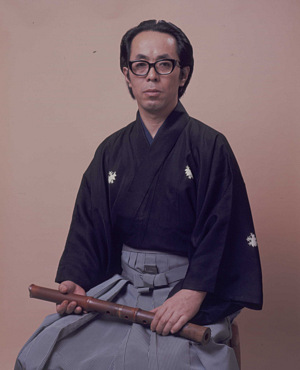 Live recordings
2. Shakuhachi Trio
- Fujiwara Dozan
- Zenyoji Keisuke
- Mitsuhashi Kifu
4. Koto Quartet
- Fujiwara Dozan (shakuhachi)
- Ikegami Shingo (koto 1)
- Tone Hidenori (koto 2)
- Kezuka Tamako (17-string koto)
5. Ajikan
- Korikawa Naoki
Multi Concert
- Funagawa Toshio (shakuhachi solo)
- Haga Mikiko (koto solo)
6. Shiki no tsuki
- Izeki Kazuhiro (Voice and koto)
7. 「覚」Ensemble Concert for Two Shakuhachi and Groups (gun)
- Inada (conductor)
- Kono Shomei or Masaaki(shakuhachi 1)
- Mitsuhashi Kifu (shakuhachi 2)
Group 1: Fujiwara Dozan, Mizukawa Toshiya, Tanabe Ryozan, Harago Takashi
Group 2-1: Sugawara Kuniyoshi, kato Hideaki, Motonaga Taku(?)
Group 2-2: Sogawa Kinya, Zenyoji Keisuke
Details of the program are here: http://www.musicon.co.jp/hunakawa.htm
Tuesday, December 22, 2009
Tamuke
My uncle passed away a couple of days ago. I came back home earlier today and played tamuke while his funeral was taking place in Japan. Facing north over incense sticks, I sat on the floor and played the piece countless times. (Later, my mother said that the monk's chanting at the funeral was extremely long. So was my playing/praying).
Tamuke has several versions. Someone told me that there are three versions. I know of only two. The most well-known version (perhaps, the only version known in the West) is Watazumi's rendering.
My learning of the piece owes much to the recording of Sakaguchi Tesshin. I notated the music by listening to his recording. Later, I noticed that my teacher's teacher learned the piece directly from Sakaguchi Tesshin, and so I got his transcription.
Tamuke is often said to have come from the Nagoya area. But my teacher's teacher believes that tamuke was composed by Takahashi Kuzan who was actually the teacher of Sakaguchi Tesshin (Sakaguchi's other teacher was Miyagawa Nyozan). The reason for his claim is that he could not find tamuke in the Fudaiji music score book. Besides, he cannot find anyone who played the piece before Takahashi Kuzan.
When I discussed tamuke with my teacher's teacher, he interestingly pointed out that tamuke has much in common with sanya, the myoan "shinpo" version of sanya (three valleys), which is a completely different piece from the taizan-ha sanya. It is played with deep tsu meri and chi meri (in the so-called miyako-bushi scale). I like this version of shinya. It carries some special import and taste. In fact, Katsuura Shozan (the last shinpo-ryu person from Kyoto Myoan temple before Higuchi Taizan took office) loved this piece. It was not just that he loved the piece, but the music was very special to him.
This afternoon, my hands naturally moved too much trying to execute Watazumi-like expressions, as I am also sort of familiar with that style. But for this occasion, the simpler version suited better. I believe that shinpo-ryu sanya also goes well for a funeral. The only problem is that the piece is too long. There is a dramatic expression near the end of the piece. But the audience needs to wait long before getting to that point.
So I did "tamuke" today (tamukeru as a verb). Hopefully, it reached my uncle's spirit before he reached Pearl Gate.
P.S. Some people say that Tamuke actually comes from Yamato or Nara. So there are more than just one homogeneous view about its origin.
Tamuke has several versions. Someone told me that there are three versions. I know of only two. The most well-known version (perhaps, the only version known in the West) is Watazumi's rendering.
My learning of the piece owes much to the recording of Sakaguchi Tesshin. I notated the music by listening to his recording. Later, I noticed that my teacher's teacher learned the piece directly from Sakaguchi Tesshin, and so I got his transcription.
Tamuke is often said to have come from the Nagoya area. But my teacher's teacher believes that tamuke was composed by Takahashi Kuzan who was actually the teacher of Sakaguchi Tesshin (Sakaguchi's other teacher was Miyagawa Nyozan). The reason for his claim is that he could not find tamuke in the Fudaiji music score book. Besides, he cannot find anyone who played the piece before Takahashi Kuzan.
When I discussed tamuke with my teacher's teacher, he interestingly pointed out that tamuke has much in common with sanya, the myoan "shinpo" version of sanya (three valleys), which is a completely different piece from the taizan-ha sanya. It is played with deep tsu meri and chi meri (in the so-called miyako-bushi scale). I like this version of shinya. It carries some special import and taste. In fact, Katsuura Shozan (the last shinpo-ryu person from Kyoto Myoan temple before Higuchi Taizan took office) loved this piece. It was not just that he loved the piece, but the music was very special to him.
This afternoon, my hands naturally moved too much trying to execute Watazumi-like expressions, as I am also sort of familiar with that style. But for this occasion, the simpler version suited better. I believe that shinpo-ryu sanya also goes well for a funeral. The only problem is that the piece is too long. There is a dramatic expression near the end of the piece. But the audience needs to wait long before getting to that point.
So I did "tamuke" today (tamukeru as a verb). Hopefully, it reached my uncle's spirit before he reached Pearl Gate.
P.S. Some people say that Tamuke actually comes from Yamato or Nara. So there are more than just one homogeneous view about its origin.
Description of Watazumi in Loori (2004)
Quotes from Loori, J. D. (2004). The Zen of creativity: Cultivating your artistic life. New York: Random House.
Doso didn’t use the highly polished lacquered and well-tuned flutes…. His flute was much less processed and far closer to its natural state. The inside of the section he used still revealed the bamboo guts. Most people, even experienced masters, considered that kind of instrument unplayable. Doso’s music proved that wrong. His playing always touched the very core of one’s being. Sometimes the sound had a tremendous strength, like the driving force of a cascading waterfall. Sometimes it roared like thunder. At other times it was gentle and sweet like birdsong at sunrise. It always seemed to reach me, but not through my ears: It entered my body through the base of my spine, moved upward, and spread through my being. (pp. 171–173)
the ability to be free in his music was the result of Doso’s life-long, unrelenting commitment to the discipline of the breath. He actually wasn’t very interested in the shakuhachi as a musical instrument. He called his flute suijo, which loosely translates as “concentrated breathing tool.” Doso saw himself not so much as a musician or entertainer, but as one who is totally devoted to developing his life force—chi [ki]—by utilizing and strengthening his breath. The bamboo flute was simply a tool for that practice. He said once, “Since I must have some way of knowing how my breath is doing, I blow into a piece of bamboo and hear how it sounds.” (p. 173)
Doso didn’t use the highly polished lacquered and well-tuned flutes…. His flute was much less processed and far closer to its natural state. The inside of the section he used still revealed the bamboo guts. Most people, even experienced masters, considered that kind of instrument unplayable. Doso’s music proved that wrong. His playing always touched the very core of one’s being. Sometimes the sound had a tremendous strength, like the driving force of a cascading waterfall. Sometimes it roared like thunder. At other times it was gentle and sweet like birdsong at sunrise. It always seemed to reach me, but not through my ears: It entered my body through the base of my spine, moved upward, and spread through my being. (pp. 171–173)
the ability to be free in his music was the result of Doso’s life-long, unrelenting commitment to the discipline of the breath. He actually wasn’t very interested in the shakuhachi as a musical instrument. He called his flute suijo, which loosely translates as “concentrated breathing tool.” Doso saw himself not so much as a musician or entertainer, but as one who is totally devoted to developing his life force—chi [ki]—by utilizing and strengthening his breath. The bamboo flute was simply a tool for that practice. He said once, “Since I must have some way of knowing how my breath is doing, I blow into a piece of bamboo and hear how it sounds.” (p. 173)
Friday, December 18, 2009
Live recording of Watazumi
A new CD of Watazumi is now released. This is not a re-release of an older CD. The first seven tracks are a recording of his live performance at "Watazumido wo kiku kai." A LP of this recording existed, and many students repeatedly listened to it. They've been hoping to have a CD version, as their old tapes are so worn out.
1. Honshirabe
2. Shingetsu (performed in two different ways)
3. Tamuke
4. Shishi (Azuma)
5. Tsuru no sugomori
6. Kyorei
7. Koku
He provides some verbal explanation about the pieces and his technique. After Honshirabe, he demonstrates basic components of his expression: Jiki, Ai, Kiri, Chu, Kai, Koku, and Mataiki, and how these can convey his feeling. It blows me away. Track 1 is a must to listen.
The CD has 12 tracks
8. Daiotsugaeshi
9. Kaze
10. Sagarinami (not Sagariha)
11. Korosugagaki
12. Matsukaze
The tile of the CD is "Wadazumido: Musōshoku, Muchōon"
1. Honshirabe
2. Shingetsu (performed in two different ways)
3. Tamuke
4. Shishi (Azuma)
5. Tsuru no sugomori
6. Kyorei
7. Koku
He provides some verbal explanation about the pieces and his technique. After Honshirabe, he demonstrates basic components of his expression: Jiki, Ai, Kiri, Chu, Kai, Koku, and Mataiki, and how these can convey his feeling. It blows me away. Track 1 is a must to listen.
The CD has 12 tracks
8. Daiotsugaeshi
9. Kaze
10. Sagarinami (not Sagariha)
11. Korosugagaki
12. Matsukaze
The tile of the CD is "Wadazumido: Musōshoku, Muchōon"
Friday, December 11, 2009
礫川餘光's interview with Tomimori Kyozan 1
This two-hour interview was recorded on October 27 in 1968. He talks really interesting stuff (such as "yabu-garashi," introduced earlier on this blog). I will be translating parts of his interview so that people (especially, my friend who kindly shared the recordings with me) can get a sense of what Tomimori Kyozan was saying.
1 Track 2
Honkyoku has gone through a few hundred years of transformation. The current form of honkyoku is different from its primitive form of origin. Among the oldest pieces are kyorei, murasaki no kyoku (which Ikkyu Zen master is said to have played), and sagariha (which was played during "nenbutsu odori," or chanting dance).
These days people often talk about koku. It is a sophisticated piece. But the initial form of the piece was not that sophisticated. Until the middle muromachi era, the shakuhachi had been 1.6 at longest. It could have been 1.4 to 1.5. Finger holes were also small. Thus, it was impossible to play half tones. There was probably no need to use semitones. The reason for no meri effect in myoan playing derives from that primitive style. In contrast, the kinko music is sophisticated. That's the influence of string instruments such as the koto, kokyu, and also shamisen (after keicho period) of the ensemble context. Hitoyogiri was also used in ensemble with shamisen....
(to be continued in the next track)
1 Track 2
Honkyoku has gone through a few hundred years of transformation. The current form of honkyoku is different from its primitive form of origin. Among the oldest pieces are kyorei, murasaki no kyoku (which Ikkyu Zen master is said to have played), and sagariha (which was played during "nenbutsu odori," or chanting dance).
These days people often talk about koku. It is a sophisticated piece. But the initial form of the piece was not that sophisticated. Until the middle muromachi era, the shakuhachi had been 1.6 at longest. It could have been 1.4 to 1.5. Finger holes were also small. Thus, it was impossible to play half tones. There was probably no need to use semitones. The reason for no meri effect in myoan playing derives from that primitive style. In contrast, the kinko music is sophisticated. That's the influence of string instruments such as the koto, kokyu, and also shamisen (after keicho period) of the ensemble context. Hitoyogiri was also used in ensemble with shamisen....
(to be continued in the next track)
Follow-up
Yes, Shimura Zenpo plays both ji-ari and ji-nashi fairly well. There are probably many professionals who play ji-ari as skillfully as he does. But when it comes to long ji-nashi, he is definitely among the best. (I am referring more to his tones than his musicality).
Other Japanese players who handle both are Izumi Takeo and Kobayashi Shomei (known more as a ji-nashi maker who is starting monthly ji-nashi "playing" lessons at Mejiro). It wouldn't be so convincing if someone who only plays either ji-ari or ji-nashi says "playing ji-ari and playing ji-nashi are two different things."
One of these people said, "The difference is not that complex. It's just that you can play ji-ari well without using the abdomen, but not ji-nashi."
Other Japanese players who handle both are Izumi Takeo and Kobayashi Shomei (known more as a ji-nashi maker who is starting monthly ji-nashi "playing" lessons at Mejiro). It wouldn't be so convincing if someone who only plays either ji-ari or ji-nashi says "playing ji-ari and playing ji-nashi are two different things."
One of these people said, "The difference is not that complex. It's just that you can play ji-ari well without using the abdomen, but not ji-nashi."
Saturday, December 5, 2009
Overcoming the ji-ari and ji-nashi demarcation
In his dissertation exploring the features of vintage shakuhachi flutes from the Edo period and performers’ bodily experiences of playing them, Shimura conceptually distinguished a group of shakuhachi practitioners who pass down and practice a repertoire of honkyoku music on the ji-nashi shakuhachi—-those belonging to what Shimura describes as the “first world”—-from other practitioners in the “second world” who play a variety of music, ranging from classical music to pop music, using the ji-ari (ji-nuri, ji-mori) kairyo shakuhachi.
In the first world, the meaning of practice is determined and acquired by experiencing the spirit of komuso shakuhachi tradition through performing honkyoku music. While the emphasis of practice in the second world is often placed on enhancing one’s musicality, the practice of the first world is characterized by its spiritual orientation, often explained through the notion of ichion-jobutsu (“one tone, enlightenment”) in which the practitioners play music for their own self-cultivation.
Shimura argues that there is no distinction between professional and amateur players in this first world. Nor is there an audience who pay admission for a professional performance. The participants practice from a sense of community; this compels them to share, acknowledge, and uplift their spiritual experience of music, like how people experience at kensokai music offering events. Often, teachers in the first world possess a strong sense of responsibility to inherit and transmit traditional forms and thus provide austere lessons.
In contrast, the second world consists of institutional, school-based groups of practitioners, in addition to independent-minded musicians, that are characterized by such ranking as shihan (teaching license) and dai-shihan (great master license). In this world, performing with other established koto and shamisen groups is also an important aspect of their activities. Shimura, though quite implicitly, contrasts the epistemological differences of the two worlds and argues that the value system of one world is not easily understood from the perspective of the other.
Shimura demarcates these two worlds in order to underscore the value system of the first world, which is mistakenly labeled as “old” and “unmusical.” His distinction (between musical and the spiritual orientations to shakuhachi playing) seems more useful than the separation between the ji-ari and ji-nashi shakuhachi. For, many of the self proclaimed ji-nashi players, despites their use of ji-nashi flutes, actually belong to the second world, in which the musical result is an important determining factor. Besides, their choice of the ji-nashi flute in the second world is often based on functional reasons (e.g., volume, pitch, playability of the instrument) rather than spiritual ones. The former is associated more with the “external” dimensions of music, and the latter with the “internal” ones.
Where do you belong? What's your value? If you come across someone from the first world, you are lucky, as most players in Japan belong to the second world these days. Hopefully, there are still a number of practitioners in hiding while practicing the spiritual shakuhachi.
In the first world, the meaning of practice is determined and acquired by experiencing the spirit of komuso shakuhachi tradition through performing honkyoku music. While the emphasis of practice in the second world is often placed on enhancing one’s musicality, the practice of the first world is characterized by its spiritual orientation, often explained through the notion of ichion-jobutsu (“one tone, enlightenment”) in which the practitioners play music for their own self-cultivation.
Shimura argues that there is no distinction between professional and amateur players in this first world. Nor is there an audience who pay admission for a professional performance. The participants practice from a sense of community; this compels them to share, acknowledge, and uplift their spiritual experience of music, like how people experience at kensokai music offering events. Often, teachers in the first world possess a strong sense of responsibility to inherit and transmit traditional forms and thus provide austere lessons.
In contrast, the second world consists of institutional, school-based groups of practitioners, in addition to independent-minded musicians, that are characterized by such ranking as shihan (teaching license) and dai-shihan (great master license). In this world, performing with other established koto and shamisen groups is also an important aspect of their activities. Shimura, though quite implicitly, contrasts the epistemological differences of the two worlds and argues that the value system of one world is not easily understood from the perspective of the other.
Shimura demarcates these two worlds in order to underscore the value system of the first world, which is mistakenly labeled as “old” and “unmusical.” His distinction (between musical and the spiritual orientations to shakuhachi playing) seems more useful than the separation between the ji-ari and ji-nashi shakuhachi. For, many of the self proclaimed ji-nashi players, despites their use of ji-nashi flutes, actually belong to the second world, in which the musical result is an important determining factor. Besides, their choice of the ji-nashi flute in the second world is often based on functional reasons (e.g., volume, pitch, playability of the instrument) rather than spiritual ones. The former is associated more with the “external” dimensions of music, and the latter with the “internal” ones.
Where do you belong? What's your value? If you come across someone from the first world, you are lucky, as most players in Japan belong to the second world these days. Hopefully, there are still a number of practitioners in hiding while practicing the spiritual shakuhachi.
Subscribe to:
Posts (Atom)